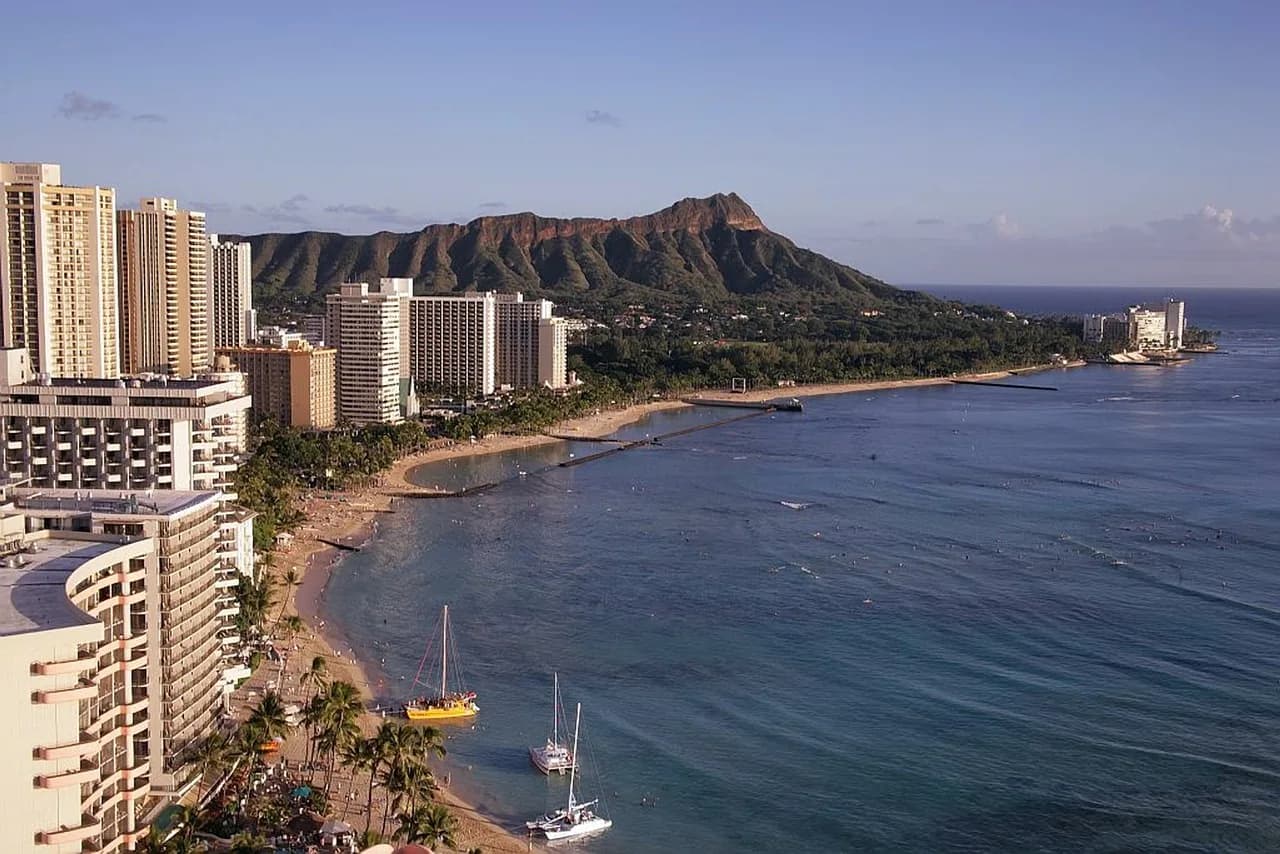
The best months to visit Hawaii are April, May, September and October. Honolulu averages under 1 inch of rain a month from April to September in NOAA's normals, and the state's 2025 count of visitors by air was lowest in September, at 674,860. Winter is wetter, mostly on the windward sides, but it is whale season. Summer is dry and busy. We read NOAA's climate normals and the state's visitor statistics on 14 October 2026.
Weather and crowds by month
Note: Temperatures and rain are NOAA's 1991 to 2020 monthly normals for Honolulu International Airport (NOAA NCEI, normals-monthly-1991-2020, station USW00022521, read 14 Oct 2026). Rain is for the airport, on the dry side of Oahu. Visitors are the state's preliminary 2025 count of visitors arriving by air, from the Department of Business, Economic Development and Tourism monthly press releases for 2025 (read 14 Oct 2026). The "P" means preliminary
| Month | Honolulu high / low (F) | Honolulu rain (in) | Hilo rain (in) | Visitors by air, 2025P |
|---|---|---|---|---|
| January | 80.5 / 66.8 | 1.84 | 7.86 | 773,149 |
| February | 80.5 / 67.1 | 1.94 | 10.22 | 739,692 |
| March | 81.2 / 68.1 | 2.36 | 12.68 | 890,010. Busiest month |
| April | 83.1 / 70.1 | 0.77 | 9.40 | 810,276 |
| May | 84.8 / 71.5 | 0.82 | 6.99 | 766,377 |
| June | 86.9 / 73.8 | 0.50 | 7.30 | 855,732 |
| July | 88.1 / 75.1 | 0.52 | 9.24 | 870,795 |
| August | 88.8 / 75.6 | 0.84 | 11.30 | 806,776 |
| September | 88.4 / 74.8 | 0.88 | 8.70 | 674,860. Quietest month |
| October | 86.9 / 73.9 | 1.51 | 10.24 | 727,212 |
| November | 84.1 / 71.8 | 2.25 | 14.39 | 728,072 |
| December | 81.8 / 69.2 | 2.18 | 12.07 | 850,263 |
We checked no hotel or flight prices, so we give no price column. Fewer visitors does not always mean lower prices. Check a fare calendar for your dates.
The NOAA Honolulu normals give the range for the year: highs of 80.5 to 88.8 F, lows of 66.8 to 75.6 F. The National Weather Service's Honolulu office adds that sea surface temperature runs from 73 or 74 F in late February and March to near 80 F in late September or early October. That page is a condensed chapter from the 1983 Atlas of Hawaii, so treat it as background.
Which month for which plan
-
Whales: January to March. The state parks office says humpbacks arrive as early as September and stay as late as May, with a peak in January and February. NOAA's sanctuary says sightings peak from January to March.
-
Dry weather on the leeward coasts: May to September. Honolulu's normals are under 1 inch in each of those months.
-
Fewest visitors: September to November in the 2025 data.
-
Warm ocean: late summer and early fall, per the Weather Service page.
Note: DLNR Division of State Parks FAQ, posted 15 Oct 2021: "Humpback Whales begin arriving at the main Hawaiian Islands as early as September and stay as late as May with the peak season occurring in the months of January and February." Most sightings are in the shallow waters between Maui, Lanai and Molokai, off the north coast of Kauai and off the Kohala coast of the Big Island (read 14 Oct 2026). NOAA's sanctuary, Feb 2022 article: sightings "peak between the months of January and March, then gradually decline until humpback season ends in early May" (read 14 Oct 2026)
The rainy season and the islands
Note: National Weather Service Honolulu, climate summary: the heaviest rains come from winter storms between October and April (page is a condensed chapter of the 1983 Atlas of Hawaii, read 14 Oct 2026)
The wet season is real, but where you stand matters more than the month. Trade winds push rain onto the windward (northeast) sides of each island, and the leeward sides sit in the lee of the mountains. These four NOAA airport stations show it. Hilo is on the windward side of the Big Island, and the other three are on drier coasts.
Note: NOAA 1991 to 2020 normals, NOAA NCEI, read 14 Oct 2026: Honolulu International Airport (Oahu), Kahului Airport (Maui), Hilo International Airport (Big Island), Lihue Airport (Kauai)
| Station | January high / low (F) | July high / low (F) | Rain, October to April (in) | Rain, May to September (in) | Rain, full year (in) |
|---|---|---|---|---|---|
| Honolulu (Oahu) | 80.5 / 66.8 | 88.1 / 75.1 | 12.8 | 3.6 | 16.4 |
| Kahului (Maui) | 82.2 / 63.6 | 89.2 / 71.8 | 13.8 | 2.4 | 16.2 |
| Hilo (Big Island) | 78.7 / 64.1 | 82.8 / 69.9 | 76.9 | 43.5 | 120.4 |
| Lihue (Kauai) | 78.6 / 66.0 | 84.6 / 74.6 | 26.0 | 10.2 | 36.2 |
We summed the monthly normals to get the two seasonal columns and the yearly total. One airport stands for each island, so the other coasts differ. The Kona side of the Big Island, Maui's south and west coasts and Kauai's north shore each have their own pattern, and we did not look them up. Mountains such as Mauna Kea are far colder than any of these stations.
Hurricane season
Note: NOAA's Central Pacific Hurricane Center covers storms from 140 degrees West to the International Date Line, which includes Hawaii. It says the season officially runs from 1 June to 30 November, but tropical cyclones can and do form in any month (NOAA, About the CPHC page, read 14 Oct 2026)
Note: NOAA's 2026 outlook for the Central Pacific gave a 70 percent chance of an above-normal season, 20 percent near normal and 10 percent below normal, with 5 to 13 tropical cyclones. A near-normal season has 4 or 5. NOAA linked the forecast mainly to El Niño and says the outlook is not a landfall forecast (National Weather Service Honolulu, 2026 Central Pacific Hurricane Season Outlook, read 14 Oct 2026)
Note: NOAA's hurricane center: "Storms that do not make landfall in Hawaii can still cause considerable damage, mostly from winds and surf" (National Hurricane Center climatology page, read 14 Oct 2026)
An outlook does not say whether a storm will reach the islands. We found no NOAA page with Hawaii landfall odds for a given month. If you travel from June to November, read the Central Pacific Hurricane Center forecast the week you fly, and check what your fare and your hotel allow you to change. That is our advice, not NOAA's.
Lahaina and Maui after the fire
The state counted 179,459 visitors to Maui in October 2025 and 243,687 in December 2025 (DBEDT press releases for those months, preliminary, read 14 Oct 2026). So Maui is open to visitors. What you can see in Lahaina is a separate question.
Note: The County of Maui Office of Recovery said on 17 July 2026 that Front Street would reopen to cars on 1 August 2026 from Pāpalaua Street to Shaw Street, with no regular restricted hours. Before that, part of the street was open only from 6 a.m. to 6 p.m. Dickenson and Prison streets were to reopen too. Market Street, Papelekane Street and Mokuhinia Place stay closed for work, including the state's dredging of Lahaina Harbor. The county asks the public to stay off private property and out of fenced areas, and says short road closures may still happen (County of Maui release, as published by Maui Now on 18 Jul 2026, read 14 Oct 2026)
Note: KITV reported on 1 August 2026 that Front Street had reopened to the public and to cars (KITV, read 14 Oct 2026)
Which Lahaina businesses and historic sites are open today, including Banyan Tree Park, is not confirmed. The county pointed readers to mauirecovers.org for the latest news. Check it before you plan a day in Lahaina.
Do I need a car on Oahu or Maui
Getting there: Honolulu's Skyline rail stops at Daniel K. Inouye International Airport at the Lelepaua station. From Lelepaua or Āhua Lagoon Drive, transfer to the W Line for Waikiki. From Āhua Lagoon Drive, transfer to the A Line or W Line for Ala Moana Center (City and County of Honolulu Skyline site, read 14 Oct 2026)
Price: TheBus and Skyline use the same fares. With a HOLO card: 2-Hour Pass $3.00, 24-Hour Pass $7.50, day cap $7.50, 3-Day Pass $20.00, 7-Day Pass $45.00, card fee $2.00. Cash on TheBus is $3.25 for one ride, exact change, no transfers. These fares took effect on 1 July 2026 (City and County of Honolulu transit fares page, read 14 Oct 2026; TheBus fare table, read 15 Oct 2026)
Oahu: If you stay in Honolulu or Waikiki, Skyline from the airport plus the W Line and TheBus cover the main areas. The city's Skyline airport page says ride-app pickup is moving from the second floor to the first floor at the airport. We did not check TheBus routes to the North Shore or the east side, so we cannot say how well they work without a car.
Price: Maui Bus fares since 1 March 2024: $2.00 one way on all routes, $4.00 for a daily pass, $45.00 for a monthly pass. Rides are free with an ID that shows you are 55 or older, with a Medicare card, with a student ID for ages 24 and under, and for children 5 and under with a paying rider. The Maui County Council sets the fare each year (County of Maui, Maui Bus Fixed Route Program page, read 14 Oct 2026)
Getting there: "The Upcountry and Haiku Islander routes stop at the Kahului Airport." The county says to check the Maui Bus schedule for times and luggage rules (same page)
Maui: The bus is cheap and reaches the airport, but we did not read the timetable, so we cannot say how often it runs or where each route goes. We also did not check bus service to Hana or to Haleakala. In our judgment, plan on a rental car if you want Hana, Haleakala and the resort coasts in one trip.
What we checked and what can change
Read on 14 October 2026: NOAA NCEI 1991 to 2020 monthly normals for Honolulu, Kahului, Hilo and Lihue airports; the DBEDT monthly visitor press releases for January to December 2025 (preliminary); the National Weather Service Honolulu climate summary and its 2026 Central Pacific Hurricane Season Outlook; NOAA's About the CPHC page; the National Hurricane Center climatology page; the DLNR Division of State Parks whale FAQ; NOAA's sanctuary article of February 2022; the Maui Now copy of the County of Maui's 17 July 2026 Front Street release; KITV's 1 August 2026 report; the City and County of Honolulu Skyline site, airport page and fares page; and the County of Maui's Maui Bus page.
Not confirmed: any hotel or flight price, which Lahaina businesses and historic sites are open today, the Maui Bus timetable, bus service to Hana, Haleakala, the North Shore or Oahu's east side, and weather on the Kona and north shore coasts. The 2025 visitor figures are preliminary and the state may revise them. We did not travel to Hawaii for this page.