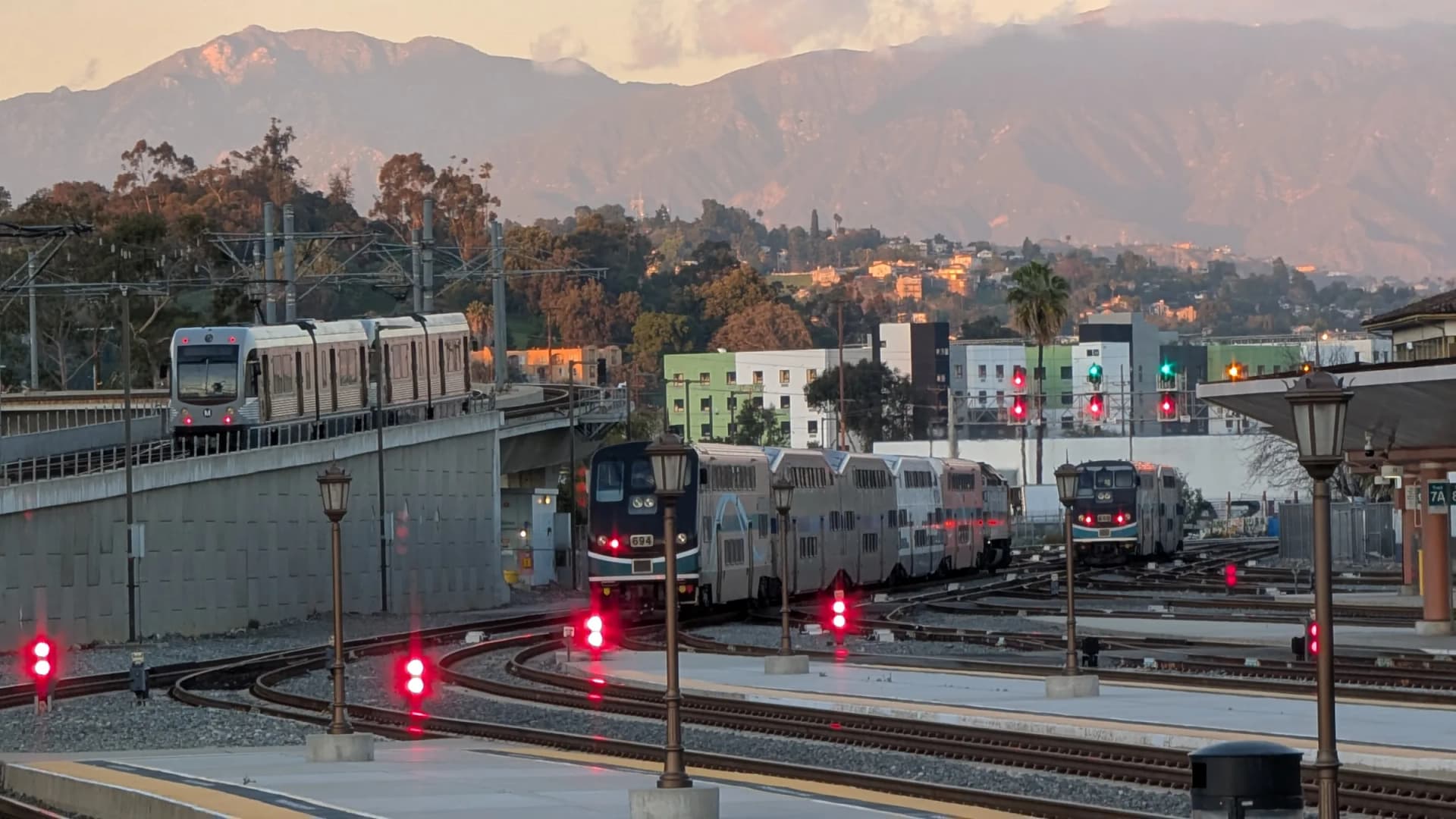
To use LA Metro, tap a contactless bank card, a phone wallet or a TAP card on the reader before you board. Each ride costs $1.75, transfers are free for two hours, and you never pay more than $5 a day. We read Metro's fares and riding pages, the TAP site and the current line timetables on 25 October 2026.
This page is the how-to: paying, the lines, LAX, hours, apps and safety. For which neighborhood to sleep in, and the sights on each line, see getting around Los Angeles without a car.
What a ride costs
| Fare | Price | What it means |
|---|---|---|
| One ride | $1.75 | Free transfers for two hours when you tap. A round trip does not count as a transfer |
| Daily cap | $5 | After three paid rides in a day, the rest of the day is free |
| 7-day cap | $18 | You never pay more than $18 in seven days |
| Seniors 62+ and riders with disabilities | $2.50 a day, $5 a week, then free | With a reduced-fare TAP card. Paying reduced fare by credit card is expected in early 2027 |
| Children under 6 | Free | With an adult who pays |
Price: $1.75 a ride, with free transfers for two hours. Fares cap at $5 a day and $18 in seven days, and the caps do not apply if you pay cash (Metro fares page, read 25 Oct 2026)
Note: There is no day pass to buy. You keep tapping, and the reader shows a free ride once you reach it (TAP fare capping page, read 25 Oct 2026)
Note: The cap counts only Metro rides (and Santa Clarita Transit). Rides on Santa Monica's Big Blue Bus, DASH and other city buses take TAP but do not count toward the Metro cap (TAP fare capping page, read 25 Oct 2026)
Note: Transfers do not count as paid rides toward the cap. Only the three paid rides do (same page)
How to pay: your own card is easiest
You can skip the TAP card. TAP readers take your own card or phone, and they charge the right fare for you.
Note: Contactless credit or debit card: Visa, Mastercard, American Express, Discover, UnionPay and JCB cards with the contactless symbol work at every gate and bus reader (TAP How to Pay page, read 25 Oct 2026)
Note: Phone or watch: Apple Wallet, Google Wallet and Samsung Wallet all work. You can also add a TAP card to Apple Wallet or the TAP app (same page)
Note: Cash: buses only, exact fare, and cash rides never count toward the cap (Metro fares page)
Price: A plastic TAP card costs $2, plus at least $1 of fare. Buy one at the TAP vending machines in every rail station, at TAP vendor shops, online at taptogo.net, or load it on a bus farebox (TAP How to Buy page, read 25 Oct 2026)
Note: The vending machines take cash and credit cards. Fare you load online can take up to an hour to reach the card, so load it at a machine if you want to ride now (same page)
Use the same card, in the same form, for every ride. Metro says to use the same card in the same payment form for your whole trip to get the cap and free transfers. So do not switch between the plastic card and the same card in your phone wallet (The Source, Metro's blog, 28 May 2026, read 25 Oct 2026).
Paying for a group
Note: Up to 5 people traveling together can pay with one credit or debit card. Tap once for each person. Each person pays a full fare, and the group gets free transfers only if it stays together and taps the same card (TAP How to Pay page, read 25 Oct 2026)
Note: A group payment counts as only one paid ride toward the card owner's cap. If you are a family of four riding all day, each adult with their own card reaches the $5 cap. One shared card does not (same page)
How to tap and ride
-
At the station, find the gate or the standing reader (a post with a round TAP target).
-
Hold your card or phone flat on the target. Wait for the green screen or the "GO" message, then go through.
-
On a bus, board at the front door and tap at the farebox.
-
Many light rail stations have no gates. Tap at the standing validator on the platform anyway.
-
On the train, board by any door. You usually do not tap when you leave. Metro says tapping to exit happens only at select stations.
Note: Metro's Customer Code of Conduct says you must show proof of fare when staff ask. A citation carries a $75 fine for adults and $40 for minors (Code of Conduct fine schedule, amended 1 June 2023, read 27 Oct 2026)
Note: Keep proof that you paid. Metro Transit Security did 29,457 fare checks and wrote 1,733 fare citations in August 2026, says Metro's safety page (read 25 Oct 2026)
Note: No eating or drinking on trains or platforms. Bikes are allowed when there is room. Big bags go in the space marked with a yellow sticker, usually at the ends of the car (Metro How to Ride Metro Rail page, read 25 Oct 2026)
The six rail lines
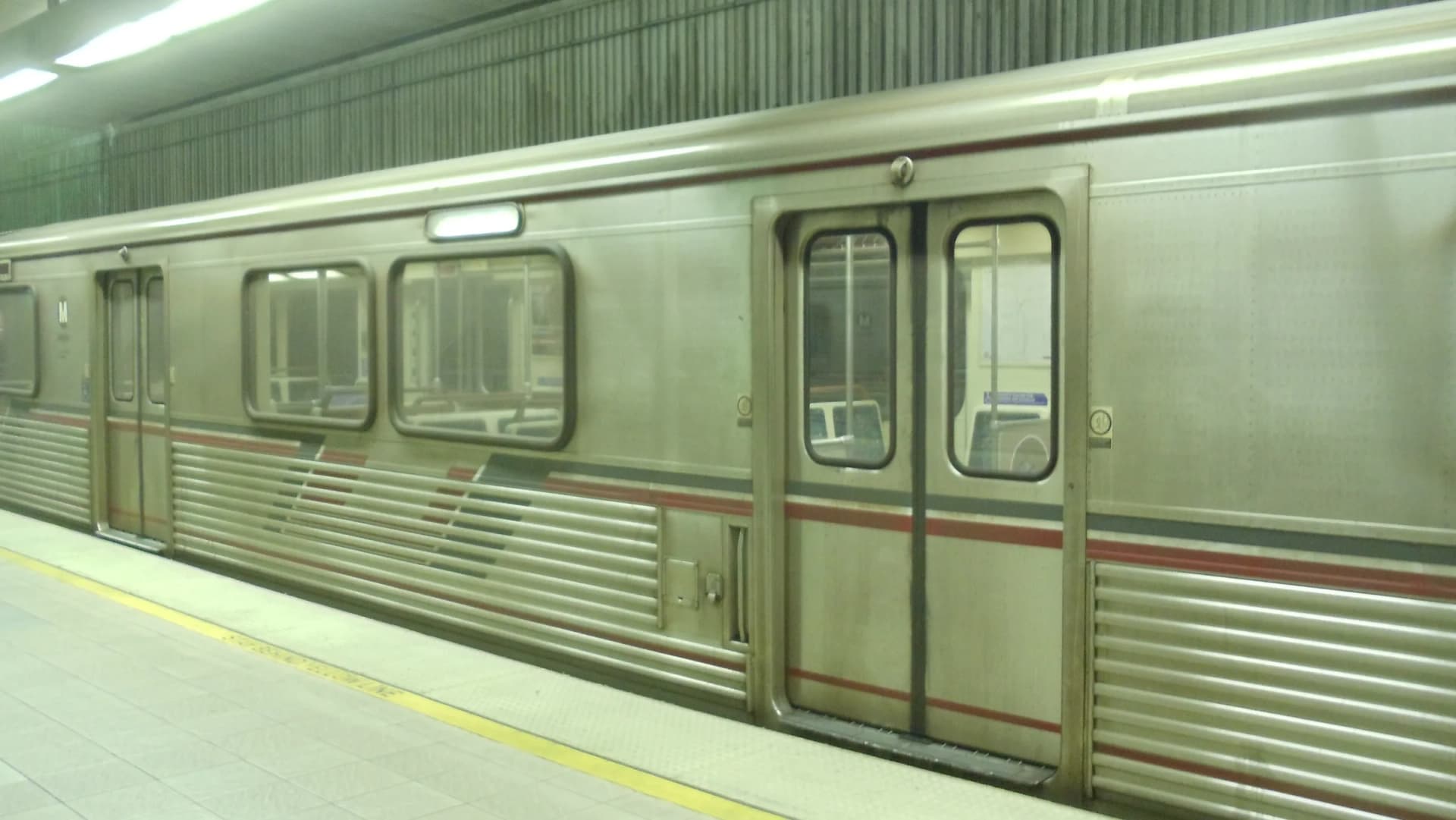
Metro has six rail lines and 115 stations. Each line has a letter and a color on the map.
| Line | Color | Runs between | Use it for |
|---|---|---|---|
| A | Blue | Pomona and Long Beach, through Downtown | Pasadena, Little Tokyo, Long Beach |
| B | Red | Union Station and North Hollywood | Hollywood, Universal City |
| C | Green | Norwalk and LAX/Metro Transit Center | LAX, east to Norwalk |
| D | Purple | Union Station and Wilshire/La Cienega | Koreatown, LACMA at Wilshire/Fairfax |
| E | Gold | East Los Angeles and Santa Monica | Expo Park, Culver City, Santa Monica |
| K | Pink | Expo/Crenshaw and Redondo Beach | LAX, Inglewood (SoFi Stadium) |
Subway: Endpoints from Metro's How to Ride Metro Rail and schedules pages, read 25 Oct 2026. The colors are the ones on Metro's rail map
Stations worth knowing
Most first trips use a short list of stations. This table names the station to get off at. Hours, prices and addresses for each place are in our car-free Los Angeles guide.
| Station | Line | What is there |
|---|---|---|
| Union Station | A, B, D | The 1939 station hall, Olvera Street across the road, Amtrak, Metrolink and the FlyAway bus |
| Chinatown | A | Central Plaza and Los Angeles State Historic Park |
| Civic Center/Grand Park | B, D | The Broad and Walt Disney Concert Hall, about a five-minute walk |
| Pershing Square | B, D | Grand Central Market and the Angels Flight railway |
| Little Tokyo/Arts District | A, E | Japanese Village Plaza, with the Arts District to the east |
| Hollywood/Highland | B | The Walk of Fame and the Chinese Theatre, right outside |
| Vermont/Sunset | B | The DASH bus up to Griffith Observatory |
| Universal City/Studio City | B | A free shuttle up the hill to Universal Studios Hollywood |
| Wilshire/Fairfax | D | LACMA and its Urban Light streetlamps |
| Expo Park/USC | E | The California Science Center and the Natural History Museum |
| Downtown Santa Monica | E | Santa Monica Pier, four blocks away |
| Memorial Park or Del Mar | A | Old Pasadena |
| Downtown Long Beach | A | Pine Avenue, with the Aquarium of the Pacific a 10-minute walk away |
Subway: Stations and sights from our car-free Los Angeles guide, checked 21 Oct 2026. For the beach end of the E Line, see things to do in Santa Monica. For the two ends of the A Line, see things to do in Pasadena and things to do in Long Beach
What changed recently
If you used an older guide or rode a few years ago, these changes matter:
-
The Regional Connector (2023) joined the old Blue, Gold and Expo lines under Downtown. The A Line now runs straight from Long Beach to Pasadena and Pomona. The E Line runs from East LA to Santa Monica. New Downtown stations include Little Tokyo/Arts District, Historic Broadway and Grand Av Arts/Bunker Hill.
-
The D Line extension opened its first new stations on 8 May 2026, according to Metro's schedules page. The line now runs past Wilshire/La Brea and Wilshire/Fairfax to Wilshire/La Cienega. Section 2 (Beverly Hills and Century City) and Section 3 (Westwood and UCLA) are still being built. Metro's project page gives no opening year for them (read 27 Oct 2026).
-
The C and K Lines were split up around the LAX/Metro Transit Center, which opened in June 2025. The C Line now runs east and west, from Norwalk to the transit center. The K Line runs north and south, from Expo/Crenshaw through the transit center to Redondo Beach. Aviation/LAX station was renamed Aviation/Imperial.
Changing lines
Subway: 7th St/Metro Center is where the A, B, D and E Lines all meet in Downtown. Union Station has the A, B and D Lines, plus Amtrak, Metrolink and the FlyAway bus. Expo/Crenshaw joins the K Line to the E Line (Metro rail map)
Note: If you pass through a gate or validator to change lines, tap again. It is free within two hours of your first tap (Metro fares page)
LAX by Metro, in short
No train goes into the terminals yet. Take the free Metro Connector shuttle from the pink LAX Shuttle signs on the lower arrivals level to the LAX/Metro Transit Center, then the C or K Line. The shuttle runs from 4 a.m. to 1 a.m., on average every 10 minutes (LAX ground transport page, read 25 Oct 2026).
For Downtown, take the K Line to Expo/Crenshaw and the E Line east, one $1.75 fare. With big bags, the FlyAway bus to Union Station is easier. Both, with times, are in our LAX to Downtown LA guide. For Santa Monica, Big Blue Bus Route 3 from the same transit center is cheaper and simpler than two trains. See our LAX to Santa Monica guide.
Hours and how often trains come
Hours: The B and D Lines start about 4:30 a.m. on weekdays. The last weekday trains leave Union Station a little after midnight, at 12:02 a.m. and 12:12 a.m. (B and D Line timetable effective 7 June 2026)
Hours: By day, B and D trains each come every 10 minutes, so the shared Downtown stretch has a train every 5 minutes. After 9 p.m. each line drops to every 20 minutes (same timetable)
Note: Metro's timetable says all service after 9 p.m. may have small delays for maintenance. Late at night, check the arrival time in the app before you walk to the station
The other lines start around 4 a.m. too. The first weekday K Line train leaves LAX/Metro Transit Center for Expo/Crenshaw at 4:01 a.m. The A Line timetable warns of maintenance delays after 8 p.m., an hour earlier than the B and D Lines.
Last weekday trains
| Line | Direction | Last train leaves | Arrives |
|---|---|---|---|
| A | To Pasadena | Union Station, 12:53 a.m. | Memorial Park, 1:17 a.m. |
| A | To Long Beach | 7th St/Metro Center, 12:43 a.m. | Downtown Long Beach, 1:42 a.m. |
| B | To North Hollywood | Union Station, 12:02 a.m. | North Hollywood, 12:34 a.m. |
| D | To Wilshire/La Cienega | Union Station, 12:12 a.m. | Wilshire/La Cienega, 12:33 a.m. |
| C | To Norwalk | LAX/Metro Transit Center, 12:20 a.m. | Norwalk, 12:51 a.m. |
| E | To Santa Monica | 7th St/Metro Center, 12:38 a.m. | Downtown Santa Monica, 1:25 a.m. |
| E | To East LA | Downtown Santa Monica, 11:56 p.m. | Atlantic, 1:03 a.m. |
| K | To Expo/Crenshaw | LAX/Metro Transit Center, 12:17 a.m. | Expo/Crenshaw, 12:38 a.m. |
Hours: Times from Metro's weekday timetables: A, B, C, D and K Lines effective 7 June 2026, E Line effective 14 December 2025 (read 27 Oct 2026). Weekend times can differ, so check the Saturday and Sunday page of the same timetable
Note: If you land at LAX late, the last C and K trains leave the transit center at 12:20 a.m. and 12:17 a.m. After that, take a rideshare
Buses, busways and Metro Micro
Metro buses cost the same $1.75 and count toward the same caps. Board at the front and tap at the farebox.
Getting there: G Line and J Line: two busway lines that Metro lists with its rail lines. The G Line runs from North Hollywood to Chatsworth. The J Line runs from El Monte through Downtown LA to Harbor Gateway and San Pedro (Metro schedules page, read 27 Oct 2026)
Getting there: Dodger Stadium Express: free with a game-day ticket. It leaves Union Station West, in front of Fred Harvey off Alameda Street, every 5 to 10 minutes from three hours before the game. Return service ends one hour after the final out (Metro Dodger Stadium page, read 27 Oct 2026). More in our Dodger Stadium guide
Getting there: Metro Micro: shared vans inside set zones for $2.50 a trip, booked in the LA Metro Micro app, at ridemicro.metro.net or by calling 323.GO.METRO. Pickups are at stops, not your door. The fare includes two hours of Metro bus and rail transfers. The LAX/Inglewood zone runs daily from 5 a.m. to 9 p.m. (Metro Micro page, read 27 Oct 2026)
Note: Metrolink to Metro: scan a valid Metrolink ticket at the Metro Rail gate, or show it to the bus driver, to transfer onto Metro (Metro fares page, read 27 Oct 2026)
The apps to download
Note: LA Metro – Official (iPhone and Android): real-time arrivals, trip planning, service alerts and nearby departures. It covers Metro and other LA transit (Metro app page, read 25 Oct 2026)
Note: TAP app: buy and load fare on your phone, ready to use right away. The minimum load is $1 (TAP How to Buy page)
Note: Transit Watch: Metro's app to report a safety problem. Metro says it works even in underground stations (Metro safety page, read 25 Oct 2026)
Google Maps and Apple Maps also show Metro routes. For live train times, the Metro app is the official source.
Is LA Metro safe?
In the daytime, on the lines tourists use, the trains are busy with commuters, students and visitors. Late at night, trains and stations are emptier, and you are more likely to share a car with only one or two other people. That is our judgment, not a statistic: we found no official crime rate per ride to quote. Our advice is to take a rideshare after about 10 p.m.
Note: Text 213.788.2777 to report a problem to Metro security. Call 911 in an emergency. You can also report through the Transit Watch app (Metro safety page, read 25 Oct 2026)
Note: Metro says it has 30,335 cameras across the system, and uniformed staff called Metro Ambassadors help riders in stations and on trains (same page)
Simple habits that help:
-
Ride in the front car, near the operator.
-
If someone bothers you, move to another car at the next stop.
-
Keep your phone in your pocket when you stand near the doors.
-
Check the block around your station before you book a hotel. Some Downtown stations are fine by day and quiet at night. Our car-free guide names the blocks.
-
Plan the last leg. After about 10 p.m., a rideshare from the station to your hotel costs little and saves a late walk.
Note: Cell service: Metro says all underground stations will have cell service in 2026. At Little Tokyo/Arts District, Historic Broadway and Grand Av Arts/Bunker Hill, only AT&T and T-Mobile work for now (Metro safety page, read 25 Oct 2026)
What first-timers get wrong
-
Buying a TAP card they don't need. Your contactless card or phone works and skips the $2 fee.
-
Switching cards during the day. Use one card or phone for every ride, or the $5 cap takes longer to reach.
-
Paying cash on the bus. Cash never counts toward the cap.
-
Looking for a train into the LAX terminals. There isn't one yet. Take the free shuttle to the transit center.
-
Expecting an all-night subway. Rail stops a little after midnight.
-
Eating on the train. It is not allowed, and staff do check.
What we checked and what can change
Read on 27 October 2026: Metro's fares page again, the schedules page, the D Line extension project page, the Dodger Stadium page, the Metro Micro page and the Customer Code of Conduct; the A, C and K Line timetables effective 7 June 2026 and the E Line timetable effective 14 December 2025. Read on 25 October 2026: Metro's fares page, Ride Metro guide, How to Ride Metro Rail page, schedules page, LA Metro app page, safety page and LAX/Metro Transit Center page; the TAP site's How to Pay, How to Buy and Reload, and Fare Capping pages; the LAX Getting To, From and Around LAX page; and the B and D Line and K Line timetables effective 7 June 2026.
Our own view, not an official source: the safety advice and the tips in the last two sections. Also read: Metro's blog post on paying with a credit or debit card (The Source, 28 May 2026). Not confirmed: whether a virtual TAP card in the TAP app or Apple Wallet costs the same $2 as a plastic card, weekend last trains, the opening date of LAX's people mover, and opening years for the next D Line stations. Fares, hours and the LAX connection can change. Check metro.net before you travel.